Mr S Roderick - Head of Department
“Having gifts that differ according to the grace given to us, let us use them” – (Romans 12:6-7)
"Learning in art provides pupils with a unique way of perceiving themselves and the world which is not taught in other areas of the school curriculum and which is essential to basic education." - (Art for ages 5 to 14 DESI'WO 1991)
Art education should make an essential contribution to a child's development, affording each pupil the opportunity to explore his or her environment imaginatively, aesthetically, creatively and practically. It has a unique role to play, therefore, in a child's intellectual and emotional development.
The aims of Art in the curriculum are to give students the opportunity.
- to develop their skills of observation, through which they can learn about the world in which they live
- to foster the capacity for imaginative and original thought and experimentation
- to develop an ability to record visual imaginative and original thought and experimentation
- to develop an ability to record visual images and through these express ideas and feelings
- to sustain an idea or theme through sequential development
- to develop technical skills i.e. drawing, painting, three dimensional work and ICT
- to collaborate effectively with others in making art
- to develop an ability to evaluate and modify both their own and the work of others
- to appreciate and respond thoughtfully to a variety of art and artefacts
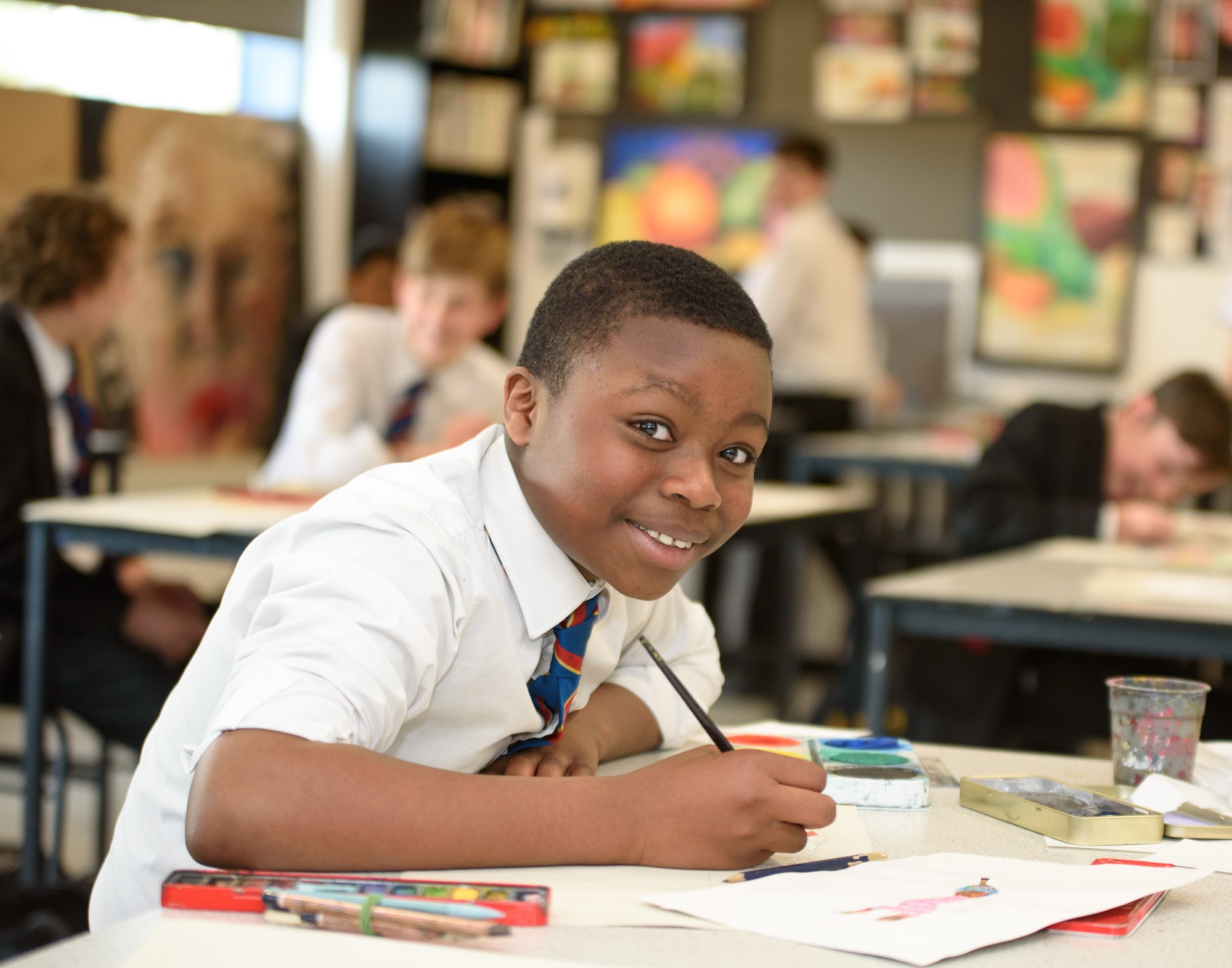
In Art students explore a range of media and subjects with the aim to enhance and develop their visual vocabulary and practical skills. Boys also continually learn about art, craft and designers, using this knowledge to inform ideas and stretch imagination.
Follow the link to view what's happening in Art for each year group.
 Key Stage 3
In the Lower School students gain a broad foundation in art using a range of two and three dimensional media. Through a series of challenging projects and exercises boys investigate drawing, portraiture, colour andcomposition, explore linear and atmospheric perspective, collage, painting, sculpture and photography. Students are continually encouraged to become independent in their learning and practice. Using a sketchbook boys develop and research ideas improving basic skills which in turn informs their art.
KEY STAGE 4
At GCSE level students follow a Fine Art or Photography specification and develop work based around topics as diverse as Portraits & Cubism, the Fauves, still-life, loose landscape and also subjects of their own choice, including the use of photography and film.
KEY STAGE 5
Art & Design affords each student the opportunity to explore their environment imaginatively, aesthetically, creatively and practically. Boys are encouraged to express ideas, feelings and meanings and make sense of these in a personal way, producing their own creative work. Options offered include Fine Art or Photography and entry is contingent on a student’s performance at GCSE and, in the case of Photography, the successful completion of an initial assessment task.
Extra Curricular Activities
Students regularly exhibit work in local and national art competitions and exhibitions. Annual competitions include the Living Edge Competition at the Lowry, Royal Academy summer on-line exhibition and the student exhibition organised by the Saatchi and Mall Galleries.
Destinations
Many old Ambrosians go on to pursue careers in Art and Design, and popular areas of study include Architecture, Fine Art, Animation, Graphic Design and the study of the History of Art. Past students have been accepted to many of the best art colleges including The Slade, Chelsea and The Courtauld Institute of Art.
Old Ambrosians: Keith Breeden is an established member of the Royal Society of Portrait Painters and Peter Saville is Graphic Designer for the music industry.